Hey there, folks, have you caught the wind of the Arc Institute's Evo 2 announcement from February 2025? Evo 2 is an AI model that's basically decoding the "language" of DNA across all life forms.
As a founder at JustPaid.ai (our YC-backed AI platform that's all about streamlining rev ops so we can focus on the fun stuff like innovating), this hit home hard.
It got me thinking on how AI could supercharge personalized medicine, not by pumping us full of synthetic drugs, but by kickstarting our bodies' natural peptide production to fix imbalances. What if we don't need Big Pharma's pills for most ailments? Our bodies are wired to heal themselves; we just need a nudge to ramp up those endogenous peptides when external crap throws things off-balance.
Evo 2: AI as the Ultimate DNA Decoder
First off, shoutout to the Arc Institute crew: they just dropped Evo 2, this beast of an AI model that's like the next evolution (pun intended) from Evo 1. Trained on over 9.3 trillion nucleotides from bacteria, plants, humans, you name it, it can process million-nucleotide sequences and predict stuff like disease-causing mutations with 90% accuracy. Think BRCA1 variants for breast cancer - boom, flagged without endless lab tests.
Quote from co-senior author Brian Hie (@BrianHie), an Assistant Professor of Chemical Engineering at Stanford University, the Dieter Schwarz Foundation Stanford Data Science Faculty Fellow, and Arc Institute Innovation Investigator in Residence.: “Just as the world has left its imprint on the language of the Internet used to train large language models, evolution has left its imprint on biological sequences.”
It's spotting patterns refined over millions of years, and it could design cell-specific gene therapies, like flipping a switch only in your liver cells to avoid side effects. For me, this screams potential for customized medicine: AI analyzing your DNA to pinpoint why your peptide levels are wonky, then suggesting ways to rev them up naturallyNo more one-size-fits-all meds; hello, hyper-personalized hacks.
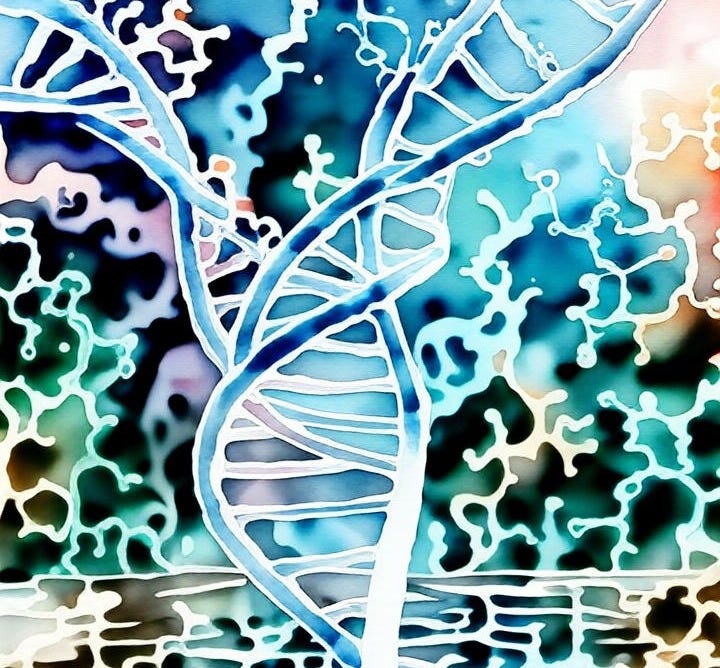
Peptides Are the Body's Built-In Pharmacy
Look, as someone pushing through the startup grind -I've seen firsthand how external factors mess with our inner balance. Stress from a funding round? Boom, cortisol spikes and throws peptide hormones out of whack. Poor diet or pollution? Suddenly, your natural repair kits aren't firing on all cylinders. But here's my opinion: we don't need pharmaceuticals for most of this. Our bodies are pros at producing endogenous peptides - short amino acid chains that act like hormones, growth factors, or anti-inflammatories to heal and regulate. Think of them as your internal Doctor Who, just waiting for a kickstart.
Imbalances happen because of stuff like obesity jacking up adipokines (peptide hormones from fat cells). https://pubmed.ncbi.nlm.nih.gov/21532839/ or chronic stress tweaking sex hormones and behavior for life, https://pubmed.ncbi.nlm.nih.gov/12649570/ or even toxins causing redox imbalances that glutathione (a peptide powerhouse) has to mop up. https://pubmed.ncbi.nlm.nih.gov/25750419/
Fix the trigger or boost production, and voila here is the natural healing without the side effects.
Science Backing: Yeah, Studies Say It's Not Just Woo-Woo
I'm all for skepticism - I've side-eyed plenty of wellness trends and snake oil influencers, but the research on peptides for healing is stacking up. Bioactive peptides from natural sources (like those our bodies make) are killer for wound healing, reducing inflammation, and even fighting cancer without relying on drugs. https://pmc.ncbi.nlm.nih.gov/articles/PMC10855437/
One review dives into how these peptides mimic hormones or ion channels to promote collagen synthesis and cell proliferation, basically turbocharging your skin or tissue repair. https://www.mdpi.com/2218-273X/15/1/88. And I’ve personally researched GHK-Cu (copper-bound tripeptide to help with that—read it here)
And get this: studies show they can act as immunomodulators or anti-infectives, all from ramping up what your body already does. External factors? Totally validated: obesity leads to abnormal peptide levels linked to prostate cancer progression, while stress or overtraining can adapt hormone responses, sometimes causing long-term imbalances
It's not gospel, and human trials are still ramping up, but PubMed's loaded with evidence that nudging peptide production could sideline a ton of pharma interventions. While some might wait for FDA approval, I know some individuals (🙋♀️) who are already experimenting and researching at home, tracking their progress and noting the results.
Where AI and DNA Fit In: The Customized Future
This is where Evo 2 blows my mind: AI like this could map your DNA sequence, spot imbalances (say, low peptide production from a genetic quirk or environmental hit), and design tweaks to kickstart it. We're talking personalized medicine on steroids where AI models predicting how mutations affect proteins, or even generating sequences for targeted therapies.
I am imagining an app analyzing your genome to suggest lifestyle hacks or biohacks that boost natural peptide output, cutting down on chronic disease downtime. My husband and I have dabbled in peptide protocols for recovery, and if AI could customize that based on our DNA? Game-changer!
Real Talk from the Trenches
As a 40-something founder, I've felt those imbalances: knee twinges from exercise, energy dips from stress. But experimenting with ways to amp up natural peptides has me recovering faster and boosting my energy levels. Tie in AI like Evo 2, and we're on the cusp of a revolution where medicine's about empowerment, not dependency. It's optimistic, sure, but grounded in the data, which is where I prefer to live and experiment.
Disclaimer
This is not medical advice. The content on this Substack is for informational and educational purposes only and is not intended to serve as a substitute for professional medical advice, diagnosis, or treatment. Always consult with a qualified healthcare provider before making any decisions regarding your health or the use of peptides.
My experiences with peptides are personal and may not be typical. Individual results can vary widely based on personal health conditions, lifestyle, and other factors. Do not rely on my experiences as a guarantee of similar outcomes.
The information provided here does not constitute an endorsement or recommendation by any regulatory authority, including the FDA or other health organizations. Some peptides may be experimental or not approved for general use.
I am not liable for any losses, injuries, or damages arising from the use or misuse of information shared on this Substack. Readers are solely responsible for their own actions and any decisions made based on this content.
The peptides discussed are for research purposes and may not be intended for human use. Please ensure compliance with all local laws and regulations regarding the purchase, possession, and use of peptides.
This post first appeared on Substack. Read the original, leave a comment, or subscribe to get the next one in your inbox.
Comments live on Substack. Subscriptions are free and go out every other Sunday.